Phonics
Why Your Child Guesses at Words
Why it happens instead of sounding out, a two-minute check for which kind of guessing you are seeing, and what to do about each.
Your child looks at the page, glances at the picture, and says a word. Sometimes it is right. Sometimes it is a word that fits the story but is not the one on the page. This is one of the most common things parents notice, and it is not a sign that something is wrong with your child.
Guessing is a sensible shortcut. It is fast, it often gets the right answer, and it gets praised. The trouble is that it is not reading the word, and most words cannot be worked out from the picture or the story anyway.
The fix is a matter of order: letters first, then the picture and the story as the check and the reward. A two-minute check further down tells you whether your child cannot sound words out yet or is not doing it, and those two children need different help.
Is it normal for my child to guess at words while reading?
Yes, and at some ages it is close to universal.
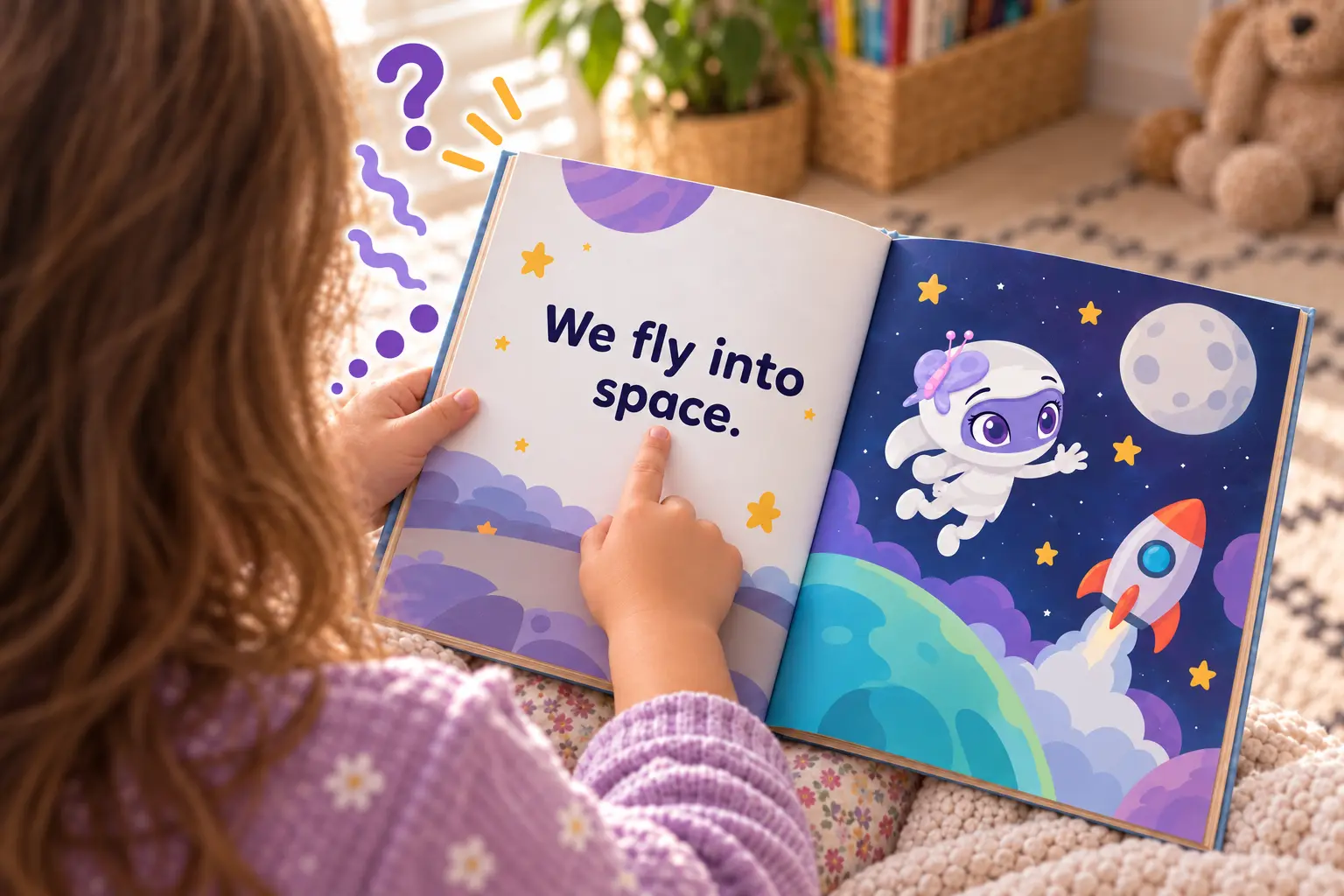
In kindergarten, it is expected, and pictures are doing useful work. Books at this stage are short, heavily illustrated and repetitive, so a guess lands often enough to feel like reading. Pictures are also part of how early reading is taught: a child who does not yet know the letter a can look at an apple and hear that the word starts with /a/, which is where beginning-sound work starts. What this page is about is narrower: a guess supplying the whole word in place of the letters, whether it comes from the picture, the first letter or the story.
In first grade, it is still common, especially in the first half of the year. Sounding out becomes reliable and then automatic during this year, and children lean on guessing less as it gets quicker.
By the end of first grade, it is worth addressing deliberately. A child still guessing at words rather than working them out from the letters, or who cannot sound out a simple unfamiliar word, is unlikely to drop the habit without a nudge. When to involve the school is further down.
Why do children guess words instead of sounding them out?
Guessing takes three forms, and most children use more than one:
- From the picture. The page shows a dog, so the word is “dog”.
- From the first letter. The word starts with m, so it might be “mother”, “make” or “my”.
- From what fits the story. Any word that keeps the sentence making sense.
All three come from the same place. Your child is trying to make the page mean something, which is what reading is for. They are reaching for the meaning before they have read the word.
Sounding out is slow. Working a word out letter by letter takes effort and several seconds. A guess takes none. When a child is tired, or wants to get to the end of the page, the shortcut wins.
Guessing often works, and gets praised. In an illustrated book about a farm, guessing “cow” is right often enough to be rewarded. A correct guess and a correctly read word look identical from the outside.
A confident guess feels safer than a slow attempt. Sounding out is visibly effortful, and it happens in front of you. Some children would rather be quick and wrong than slow and watched.
Some children were taught to do it. For many years, a widely used approach encouraged children who got stuck to look at the picture, think about what would make sense, and check the first letter. Many schools are moving away from it. If your child was taught this, they are following instructions, not misbehaving.
Is guessing bad for my child’s reading?
Not in the way most parents fear, and the honest answer has four parts.
Attempting words is good. A child who guesses is engaged with the page and expects it to make sense. That instinct is worth keeping. What needs to change is the method, not the willingness.
Most words cannot be guessed. In ordinary text, the next word is not predictable from what came before. A 2016 study in Cognitive Psychology collected readers’ guesses at all 2,689 words of 55 ordinary passages: the words that could be reliably predicted were rare, and most words had a likelier-seeming competitor that was not the word on the page. A strategy that relies on the story supplying the word fails more often than it succeeds, and it fails quietly: a wrong word that fits the sentence does not sound like an error.
A guessed word does not stay learned. When a child works a word out from its letters, the spelling, the sound and the meaning get connected in memory. Do that a few times and the word stops needing to be worked out at all: it becomes a word your child knows on sight. Reading researcher Linnea Ehri calls this orthographic mapping, and it is where fluent reading comes from. Every word read from its letters is a deposit.
A guess builds none of that. Your child can guess the same word correctly a dozen times and still not be able to read it on a page with no picture. So guessing is not just an unreliable way through today’s book. It is a way of reading a whole book and learning nothing from it.
Context has a real job, just later in the order. Once your child has read a word from its letters, the picture and the story are exactly what confirms it. Did that make sense? Does the picture match? That is how strong readers use context, and reading researcher Timothy Shanahan puts it exactly that way: context is a check on a word rather than a tool for reading it. The problem is the order.
Can my child sound words out? A two-minute check
Two very different children guess at words. One cannot sound words out yet, so guessing is the only tool they have. The other can, but guessing is faster. They need opposite help, and this check tells you which you have. Guessing is more common when sounding out is hard, so it is worth finding out rather than assuming.
If you have already tried an unfamiliar word with your child as part of our reading check, you know the answer and can skip this.
Write five words
On a piece of paper with no pictures near it, write three real words, nap, fig and mud, then two made-up words, mip and dut. Tell your child the last two are the names of two tiny aliens.
Start with the real words
Ask your child to read the three real words first, so the check starts with a win. Keep it light: this is a game, not a test.
Then the alien names
Ask for the two made-up words. Listen for whether your child works through every sound, says a real word that starts the same way, or cannot put the sounds together at all.
| What your child does | What it means | What to do next |
|---|---|---|
| Works through the sounds and gets there, even slowly | They can sound words out. The guessing is a habit, not a gap | Everything in “How can I help my child stop guessing words while reading?” is written for you |
| Says a real word with the same first letter, “mop” for mip | They read the first letter and guess the rest: part of the skill, skipping the harder part | The same help, with extra attention to finishing the word |
| Says the sounds but cannot put them together, or cannot start | Sounding out is not there yet, so guessing is the only strategy they have | Start with blending: my child knows letter sounds but can’t sound out words |
If your child reads familiar words fluently but stalls on the alien names, the third row is the answer too: words that have been memorised can look a lot like words that have been read.
Why the made-up words matter most. Nobody has memorised mip. There is no picture of it and no story it fits into, so the only way to read it is from the letters. Schools use the same trick: England’s Year 1 phonics screening check mixes made-up words in with real ones and marks each made-up word as the name of an imaginary creature, so children do not try to match it to a word they know.
How can I help my child stop guessing words while reading?
The principle behind all of this is the same: letters first, reward after.
When they get stuck, send them to the first sound. Not to the picture, and not to “what would make sense”. Point at the beginning of the word and ask what sound it makes, then work across the word together. If your child cannot hold the sounds together into a word, that is a separate skill with its own blending techniques.
Let the picture be the payoff. Read the word first, then look at the picture together to see whether it matches. The picture becomes a reward rather than a shortcut. It does not go anywhere, it comes second, and there is no need to avoid illustrated books: pictures are a large part of why early reading is enjoyable.
You do not need to correct every guess. Correcting all of them will make your child stop taking risks. When you do step in, send them back to the letters without making it a no:
- “What sounds do you see?”
- “Start me off with the first sound.”
- “Check the end of that word for me.”
- “Close. Try it again from the letters.”
Praise the attempt rather than the result. “You read that one right across the word” tells your child what to repeat. “Correct” does not. Let small guesses go when your child is tired, enjoying the story, or near the end of a book.
Give them books they can win at. For your child’s own practice reading, books built only from sounds they already know let them succeed by sounding out. These are sold as decodable books, and our guide to free phonics resources lists two free sources. Keep reading picture books aloud together as well. Those are for story, vocabulary and pleasure, not practice.
Keep it short and regular. Five minutes of reading where your child does the work beats a long session that ends badly, and most days beats once a week.
If you are weighing an app, our comparison of phonics apps sets out five options, including where our own falls short.
What if my child gets frustrated when they stop guessing?
Expect a dip, and expect it to look like going backwards.
A child who has been guessing fluently has been getting through books at speed. Asking them to sound words out makes reading slower and more effortful overnight, and children notice. Some get upset. Some insist they already know how to read, which, from where they are standing, is a reasonable thing to think.
Say what is happening. “You are going slower because you are doing the hard part yourself now. That is the bit that makes you a strong reader.” Children handle a dip much better when it has been named in advance.
Keep sessions short and stop while it is still going well. Five minutes is plenty. Ending on three words your child got right is worth more than a fourth attempt that goes wrong.
Keep story time separate. Reading aloud together stays as it was. If practice starts eating into the part of reading your child loves, the trade is not worth it.
This dip is temporary, and it is a different kind of frustration from a child who has tried and failed to blend at all. For that one, see how to handle frustration during blending practice.
When should I be worried about guessing?
Guessing on its own is rarely the thing to worry about. It is worth a closer look when it comes with other signs.
Talk to your child’s teacher if:
- Your child is at the end of first grade and still guessing at words from pictures rather than the letters
- Your child cannot sound out a simple unfamiliar word, like the made-up words in the check on this page
- Your child reads familiar books fluently but cannot read the same words on a plain page
- Guessing gets worse rather than better over a term of ordinary schooling
- There is a family history of dyslexia or reading difficulty
If the school has already raised a concern with you, what “behind in reading” actually means covers what those conversations involve and what to ask.
For the wider view, our reading check by age walks through what is typical at each stage from three to seven, and what to raise at a parent-teacher meeting.
Frequently asked questions
Do guessing habits go away on their own?
Sometimes. When a child's sounding out gets quick enough, guessing stops being the easier option and fades. Often it does not, because every guess that turns out right gets rewarded. A few weeks of sending your child to the letters first, and letting the picture confirm the word afterwards, usually shifts it.
Can picture books hinder or help my child's reading?
They help. Picture books build vocabulary, story sense and the expectation that reading is worth doing. When your child is reading, make sure they read from the written word first and then check it against the picture.
Is my child just a visual learner?
Probably not in any way that changes how reading should be taught. Reading runs through letters and sounds for every child, and researchers who reviewed the learning-styles evidence in 2008 found no adequate evidence that matching teaching to a preferred style improves learning. A child who leans on pictures is usually showing that working out words is still hard.
Are there apps that can help children read without guessing?
Some can, and the useful ones share three features. They give children words they have not seen before, they do not put a picture beside a word the child is reading, and they have the child read the word before showing anything that would give it away. An app is extra practice alongside reading together, not a replacement for it.
Related guides
Last updated