Sight words
How to Teach Sight Words
How to sort the list your school sent, how many words your child actually needs, and what five minutes a day should look like.
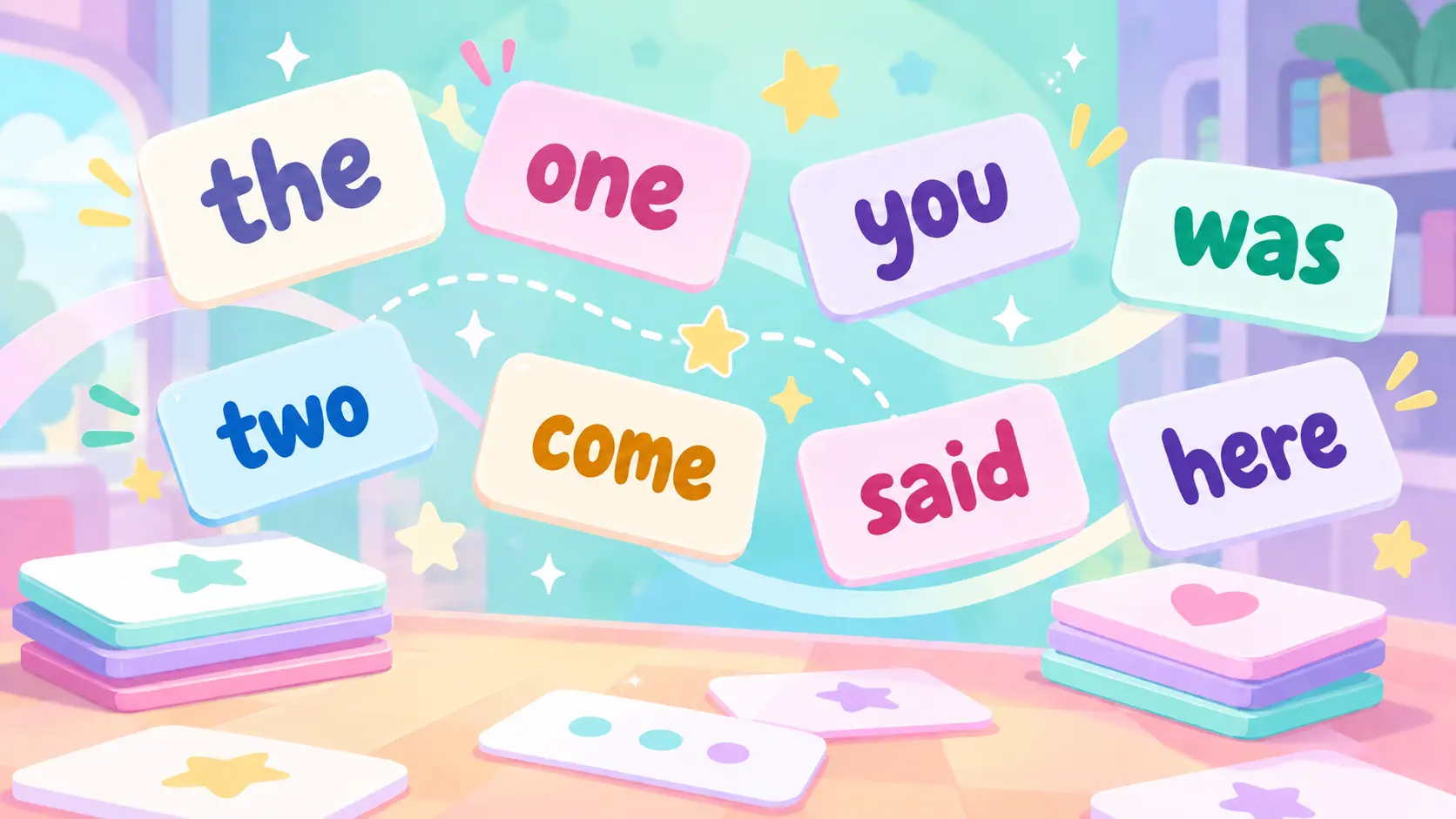
Sight words are the common words that do not play by the usual spelling rules. One is the clearest example: it is spelled o-n-e and says “wun.” Said, was, of, the and two are the same kind of word. Sounding them out gets your child partway and then leaves them short, which is what makes them frustrating.
The reason they are worth learning by sight is how often they turn up. Reading researcher Timothy Shanahan puts the hundred most frequent words at about half the words a child meets in any text, and a word that common is worth recognizing instantly rather than working out every time.
The job is also smaller than the list in the backpack suggests. School lists come from Dolch and Fry, which rank words by how common they are rather than how tricky, so many of their words are ordinary ones your child can already sound out. And there is no national requirement for how many: reading researcher Timothy Shanahan suggests about twenty by the end of kindergarten. Twenty known solidly beats a hundred half-remembered.
What are sight words, and why can’t my child sound them out?
A small group of very common words do not follow the usual spelling rules, and they are the ones your child meets earliest. One is spelled as though it should say “own.” Of ends in an f that says /v/. Said looks like it should rhyme with paid.
A child who sounds out said and arrives at “sayed” is doing everything right. That is worth telling them out loud, because a child who concludes that sounding out has failed them will often stop trying it on the words where it works.
The standard most schools work from says so in almost those terms. Common Core RF.K.3c asks kindergartners to “read common high-frequency words by sight,” and names ten examples: the, of, to, you, she, my, is, are, do, does. Notice what it does not do: it gives examples and never gives a number.
Where do the lists come from? Almost every school list is drawn from one of two, and they differ mainly in how they are sorted.
The Dolch list holds 220 words grouped by grade band, from pre-K through third. They are the “service words,” the ones doing grammatical work: the, said, was, go, little, funny. Nouns are deliberately left off and kept on a separate list of 95, because a child can often get a noun from the picture on the page. The Fry list makes no such distinction and leaves nothing out. It ranks the 1,000 most common words in order, in groups of a hundred.
So Dolch sorts by roughly when a child needs a word, and Fry by how common it is. For a kindergartner the two barely differ, since Dolch’s earliest bands and Fry’s first hundred cover much the same ground. Neither was built to separate the words that need memorizing from the words that do not, which is why sorting yours is the first thing to do. The Dolch sight words page has every Dolch word already sorted that way, level by level.
How many sight words should my child know?
There is no national number. The kindergarten standard quoted above names ten example words and specifies no count at all. Every target your child has been given was set by a district, a school, or a teacher.
So the targets vary enormously. Some ask for twenty-five words by the end of kindergarten, others for a hundred. Neither figure comes from research. As Timothy Shanahan puts it, “the research is not terribly specific as to how many words should be taught or when.”
His own suggestion for the end of kindergarten is “perhaps 20 words or so, with at least 10 of those being high frequency words.” For the end of first grade he recommends the 100 most frequent words. He also notes that even with considerable effort, that first hundred is typically not mastered by most children until around Thanksgiving of first grade, which is well into the year after the one most parents are worrying about.
Three things follow, and they are worth holding onto if your child’s list feels heavy.
A shorter list learned properly beats a longer list drilled. A child who reads twenty words without pausing is in better shape than one who has been marched through a hundred and hesitates on most of them.
Being behind the list is not the same as being behind in reading. Word counts are easy to measure, which is why schools measure them. They are a narrow slice of what your child is actually learning, and a wider set of check-ins by age is in is my child on track with reading?.
The number matters less than whether the words transfer. Reading a word on a card is not the same skill as reading it in a book, and only one of those is the point.
If the list feels out of step with where your child is, that is worth a calm conversation with the teacher rather than a harder push at home. Ask which words their list prioritizes, and start with those.
Which words on the list actually need memorizing?
Take the list your school sent and split it into two piles. This takes ten minutes once and saves weeks of misdirected practice.
| Pile one: sound these out | Pile two: learn these by heart |
|---|---|
| and, can, in, it, up, on | the, said, was, you, of, to |
| big, run, did, not, jump, red | come, one, two, where, there, have |
| Ordinary words that happen to be common. No memorizing needed. | The spelling breaks the usual pattern. This is where repetition goes. |
| If your child can sound them out, they are finished. If not, this is phonics practice. | Map the odd part, then practice the word over weeks. |
Pile one needs no memorizing at all. Drilling these as whole words teaches your child to guess at words they could have read, which is a habit that costs far more later than the minutes it saves now.
Pile two is where the repetition goes, and it is usually much shorter than parents expect.
There is a published figure for how short. Reading specialists Linda Farrell, Michael Hunter and Tina Osenga, writing for Reading Rockets, report that 138 of the 220 words on the Dolch list, or 63 percent, are decodable once all the regular spelling patterns are taken into account. That leaves 82 words across the whole list that genuinely have to be learned another way. Your kindergartner does not have fifty words to memorize. They have a fraction of that, plus a stack of ordinary words to practice sounding out.
Our first grade spelling list is sorted the same way, if you want to see the split applied to a real set: have, they, said, was and come are the ones on it that do not play by the rules. The most common words of all come already sorted in the kindergarten, 1st grade and 2nd grade sight word lists.
Before any of this works, your child needs to know most letter sounds and be able to hear individual sounds in spoken words. If your child knows their letter sounds but still cannot push them together into a word, that is a different problem with a different fix, and it comes first: my child knows letter sounds but can’t sound out words.
How to practice so the words stick
Repetition is the method, and there is no shortcut that replaces seeing a word many times over many weeks. What separates practice that works from practice that does not is how those repetitions are spread out and what your child does with them.
Little and often. Five or ten minutes on most days beats half an hour on a Sunday. Words fade unless they are pulled back out of memory regularly, and the pulling out is what strengthens them.
Review matters more than new words. This is where home practice most often quietly fails. Two or three new words a week is plenty, but every session should include a mixed pile of words learned earlier. A word is not finished the first day it is read correctly.
See it, say it, write it. Show the word and say it together. Have your child say it while looking at it. Then have them write it while saying it. Writing matters more than it looks like it should, because it forces attention onto every letter in order rather than onto the general shape.
Use it in a sentence. Say a sentence containing the word, or better, write a silly one together and have your child read it back. Some of these words mean almost nothing alone. Of and was only make sense inside a sentence.
Keep it out of bedtime reading. Stories should stay stories. Practice gets its own slot, ideally when nobody is tired.
How much practice is enough?
Five to ten minutes a day, on most days. Longer sessions do not produce more learning at this age, and they reliably produce more resistance.
A routine that works:
- Two minutes on the current word: see it, say it, write it
- Three minutes on a mixed pile of words learned earlier
- One sentence containing the word, read aloud from a book or written together
Two or three new words a week is a good pace. If a word is still shaky after a week, keep it in the pile and do not add a new one on top of it.
Children vary a great deal in how many times they need to see a word before it becomes automatic. A child who needs many more repetitions than a sibling or a classmate is not doing anything wrong, and steady daily contact matters far more than speed does.
Games and activities that beat plain flashcards
Flashcards are fine as one tool. The problem is that twenty minutes of them produces a child who does not want to do this again tomorrow. Each of these spreads the same repetitions across something that feels less like a test, and all of them work with paper and a pencil. Sight word games and activities has nine of them in full, with which words belong in a game and how long to play. If you would rather some of that practice happened on a screen, best sight word apps compares nine of them on price, whether they take your child’s own list, and whether they are still updated.
Word hunt. Write words on sticky notes, hide them around a room, and have your child read each one as it is found. Movement helps a lot of children at this age.
Find it in a book. Pick tonight’s word and hunt for it on a real page. This is the most valuable activity on the list, because reading the word inside real text is the thing you actually want.
Memory match. Two cards per word, played as pairs. Your child reads each card as they turn it over.
Rainbow writing. Write the word once, then trace over it in three different colors, saying it each time.
Silly sentences. Build a sentence together using the word, the sillier the better, then have your child read it back.
Bingo. A grid of practiced words, called out one at a time. Works well with a sibling, and gets a lot of repetitions in quickly.
What if my child is 3 or 4?
Then sight words are not the job yet. At three and four, the useful work is letter sounds, hearing sounds in spoken words, rhyming, and being read to.
A preschooler who recognizes their own name and a couple of words from a favorite book is doing exactly what they should be doing. There is nothing to catch up on.
Starting sight words before a child knows letter sounds means asking them to memorize shapes with nothing to anchor them to, which is slower rather than faster. The waiting is not lost time.
What to avoid
Do not memorize words your child could sound out. It is wasted effort, and it can teach a child to guess at words instead of reading them. This is what the sorting above is for.
Do not add new words while old ones are shaky. The most common way home practice stops working.
Do not run long sessions. Ten minutes of willing practice beats thirty minutes with a child who has checked out.
Do not correct every error. If they miss a word, say it for them, have them say it back, and move on. Turning each mistake into a lesson turns practice into something they dread.
Do not treat the school list as a deadline. It is a plan for a year, not a test your child is currently failing.
How to tell it’s working
The test that matters is transfer. Can your child read the word in a book they have not practiced, inside a sentence, without a pause? A word read on a card but missed on a page is not finished.
Over two to four weeks of short daily practice, look for:
- Words read instantly rather than visibly worked out
- Old words still solid when they reappear weeks later
- Your child spotting a practiced word in a book on their own
- Less resistance to practice, which usually means it has stopped feeling like a test
If a word keeps slipping no matter how often it comes up, try shrinking it. Circle only the part that is genuinely odd, and let your child see how much of the word they already know. My child can’t remember sight words works through the seven usual reasons a word does not stick, and what to change for each one.
Frequently asked questions
At what age should children start learning sight words?
Usually around five, once your child knows most letter sounds and can hear the separate sounds in spoken words. Those two skills are the starting gun, not a birthday. A child who cannot yet do either will be memorizing shapes with nothing to anchor them, which is slower rather than faster.
How many sight words should a kindergartner know by the end of the year?
There is no standard answer. School targets commonly range from about twenty-five to a hundred, and reading researcher Timothy Shanahan suggests roughly twenty words is a more realistic goal, with at least ten of those being high-frequency words. Ask your child's teacher which words on their list matter most and start there.
Dolch or Fry, which list should we use?
Either. The Dolch list holds 220 words grouped by grade band, plus a separate list of 95 nouns. The Fry list ranks the 1,000 most common words in order of how often they appear, in groups of a hundred. Dolch sorts by roughly when a child needs a word and Fry by how common it is, but for a kindergartner the two cover much the same ground, so the practical answer is to use whichever your school uses.
Should my child be able to spell them too?
Reading comes first. Most schools do not expect kindergartners to spell these words, though writing a word is one of the better ways to learn to read it, because it forces attention onto every letter in order rather than the general shape.
How often should we review words we have already learned?
Every session, in a mixed pile with the current word. Words that are never revisited fade, and a faded word takes almost as long to relearn as it took to learn the first time. Review matters more than adding new words, and it is the step home practice most often drops.
Do sight words help with reading fluency?
Yes. Every word your child recognizes instantly is attention freed up for understanding the sentence rather than assembling the word. That is why the most common words matter more than their number suggests. Timothy Shanahan puts the hundred most frequent words at roughly half the words a child will meet in any text.
My child knows the words at home but not at school. Why?
Usually because home practice happened on cards and school asks for the words inside sentences. Reading a word on a card and reading it in a book are close but not identical skills. Practice finding the words in real books, which closes that gap faster than more card work does.
Are apps better than flashcards for sight words?
Both work by repetition, so the more useful question is which one your child will still be doing in six weeks. What matters more than the format is that decodable words are being sounded out rather than memorized, because drilling a word your child could have read teaches them to guess.
Related guides
Last updated