Phonics
Hearing the Sounds in Words
What phonemic awareness is, what is normal at each age, and the five-minute spoken games that build it at home.
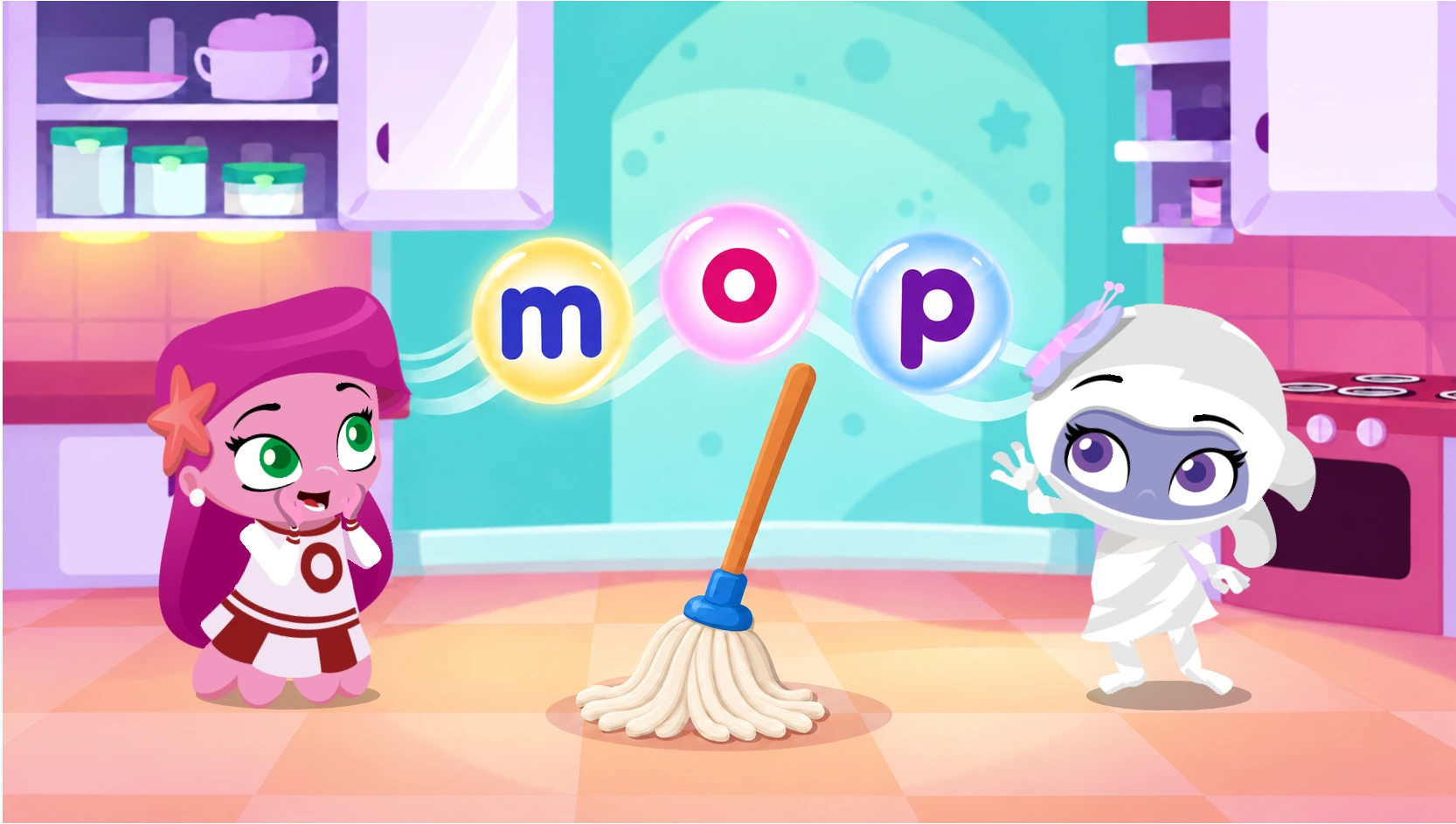
A child might know the letter M but still have trouble hearing that “mop” begins with the /m/ sound. Knowing letters and hearing the sounds in a spoken word are different skills, and the second is part of what educators call phonemic awareness.
Phonemic awareness is the ability to hear the individual sounds in speech, tell them apart, and put them together into words. It comes before letters and is learned by ear, without paper or screens.
Here is what that looks like, what is normal at each age, and what helps at home.
What is phonemic awareness, and how is it different from phonics?
Phonemic awareness is learned through listening. It is hearing the word “bat” and understanding that it holds the sounds /b/, /a/ and /t/, and a child can practice it with their eyes shut. Phonics is linking those individual sounds to the letters b, a and t on the page: learning what sound each letter stands for.
Phonemic awareness provides the building blocks for phonics. For a child to map sounds onto letters, those sounds must already be separable in their head.
What phonemic awareness makes possible
Each of these builds on hearing the sounds in words, roughly in the order a child meets them.
| Reading skill | How phonemic awareness supports it |
|---|---|
| Beginning phonics | A child can connect a sound they hear in a word with the letter or letters that represent it. |
| CVC words | Hearing each sound helps a child blend the sounds: /m/ /a/ /p/ becomes “map”. |
| Blending | A child can blend a sequence of sounds to recognize the word instead of relying on memory or pictures. |
| Spelling | A child can break a spoken word into its individual sounds, then choose letters to represent them. |
| Reading accurately | Paying attention to every sound helps a child read the whole word instead of guessing from the first letter. |
Is it normal that my child cannot hear the sounds in words?
Yes. It is normal at four and throughout kindergarten. The Common Core State Standards, which set out what many US schools teach, list hearing the first, middle and last sounds of a short word as a skill for the end of kindergarten, when most children are six. A four-year-old who cannot yet pick out the first sound in “mop” is not behind that expectation.
Rhyming and syllables usually develop on their own during the preschool years. Children start enjoying rhymes, notice that two words sound alike, and clap along to the beats in a word, through nursery rhymes, songs and ordinary play.
Hearing the individual sounds inside a word is different. It can need additional, targeted practice.
The skills below are in the order the Victoria Department of Education’s literacy teaching toolkit sets them out. The right-hand column is what the Common Core standards expect.
| Skill | What it sounds like | Common Core expects it by |
|---|---|---|
| Clapping syllables | ”But-ter-fly” is three claps | End of kindergarten |
| Hearing and making rhymes | ”Cat” and “hat” sound alike, and “bat” does too | End of kindergarten |
| Hearing the first sound | ”Mop” starts with /m/ | End of kindergarten |
| Blending and separating sounds (a) | /m/ /o/ /p/ is “mop”, and “mop” is /m/ /o/ /p/ | Words of three sounds, by the end of kindergarten |
| Blending and separating sounds (b) | /s/ /t/ /o/ /p/ is “stop”, and “stop” is /s/ /t/ /o/ /p/ | Words of four or five sounds, where two consonants sit together, by the end of first grade |
| Swapping or adding a sound | Change the /m/ in “mop” to /t/ and it becomes “top” | End of kindergarten |
What matters more than the exact month is direction. A child who could not clap syllables in the spring and can in the fall is moving. For a quick look across all the early reading skills at once, not only this one, our five-minute reading check-in shows what is typical at each age from three to seven.
Being on track at four does not mean it takes care of itself. The National Reading Panel found that phonemic awareness and letter knowledge are the two best predictors, at school entry, of how well a child learns to read over the first two years. A few minutes a day of spoken sound games is enough to build it.
Which comes first, and how do I know my child is ready for phonics?
Sounds come first and letters second, with a long overlap in the middle. Most children are working on both at once by the time they start school.
Your child is ready for letter work when they can do most of these:
- Clap or tap the syllables in their own name
- Hear that two words start with the same sound
- Tell you the first sound in a short, familiar word
- Say the word when you give them the sounds slowly, /m/ /a/ /n/
They do not need to be perfect.
If your child can do those things, the next step is letter sounds: the sound each letter makes, not its name. Once a few are secure, the step after that is pushing them together into printed words, which is where most children get stuck. What order to teach phonics sets out the whole sequence, and our guide to blending covers that step and the pronunciation habit that most often stalls it.
This transition is also the first point where an app is useful. Until letters are involved there is nothing for a screen to do, because the work is listening and talking. If you are weighing apps, our comparison of phonics apps looks at five, including ours and where it falls short.
What to do at home in five minutes a day
Phonemic awareness games are all spoken. None of them needs paper, and none of them needs a screen.
Start with the first sound. Pick a word and ask what it starts with. Begin with sounds you can stretch, like /m/, /n/ and /f/, because a child can hear them held out. “Mmmmop. What sound does mop start with?” Sounds like /b/, /t/ and /k/ stop the moment they start and are harder to catch.
Play I Spy with sounds instead of letters. “I spy something that starts with /m/.” Say only the letter’s sound, not its name.
Clap the beats in words. Start with your child’s own name, then longer words like but-ter-fly and el-e-phant.
Say a word in slow motion and let them guess it. “/c/ … /u/ … /p/. What did I say?” Then swap and let them break a word apart for you.
Play with the small pieces. Ask what “sun” becomes without the /s/. This one comes after hearing the first sound, so treat it as a game rather than a test.
Rhyme during the ordinary parts of the day. Nursery rhymes, songs in the car and rhyming books all count, and this one mostly takes care of itself. If it is not taking care of itself, how to teach rhyming has the four steps in order and what to do when your child can hear a rhyme but cannot make one.
Use the time you already have: the walk to school, the bath, the line at the store. Five minutes of this most days does more than a long session once a week.
Every game above is the letterless stage, played out loud. Sound boxes are how the same work moves onto paper: a square for each sound, a counter pushed into it, and letters only once the counters are easy.
Signs your child is struggling, and what they mean
These signs are ordinary at three and four, and worth paying attention to from five onward:
- Cannot tell you the first sound in a word, even with the sound stretched out
- Does not notice when two words rhyme, well past the fourth birthday
- Cannot clap the syllables in a short word
- Guesses at whole words rather than hearing parts of them
- Can repeat a word back perfectly but cannot break it apart
A 30-second check
Pick three short words
Choose three short words that start with a sound you can stretch, such as mop, nut and fan. The sounds /m/, /n/ and /f/ can be held out, which makes them easier to hear, and almost every four-year-old can already say them.
Say one and ask
Say the first word clearly, stretching its first sound a little (mmmop), and ask what sound it starts with. Listen for the sound, not the letter name.
Help, then move on
If your child is stuck, say the sound yourself and try the next word. Count how many of the three they got without help.
Most of three, comfortably. Your child can hear the first sound in a word, which is the skill letter work leans on first. Letter sounds are a sensible next step, with the spoken games carrying on alongside.
One or two, or only with heavy help. This is normal at four. Play the spoken games in “What to do at home in five minutes a day” for two or three weeks and check again.
None of them, and your child is five or older. This is worth raising with their teacher. Ask what they see at school and whether the school screens for this.
When this is a speech or language question, not a reading one
Sometimes a child is not struggling to hear sounds inside words. They are struggling with sounds more generally, and the reading question is downstream of that.
It is worth a conversation with a professional if any of these are true:
- Other adults often cannot understand your child’s speech
- Your child leaves out or swaps sounds in their own speech well past the age their peers stopped
- Your child seems not to hear you, or asks for repetition constantly
- There is a family history of reading or speech difficulties
- Your child is five or older and none of the listening skills in the age table (syllables, rhymes, first sounds) are in place
The American Speech-Language-Hearing Association’s speech sound chart shows the ages most children say each sound by, which shows whether a sound your child swaps is still expected at their age.
Start with your pediatrician or your child’s teacher, who can tell you whether a referral makes sense. A speech-language pathologist assesses how a child produces and processes speech sounds, and many also work directly on hearing sounds inside words. If hearing itself is in question, that gets checked first, because everything else rests on it.
The association’s ProFind directory lists more than 20,000 certified speech-language pathologists and audiologists who are accepting referrals, and it is where to start if you want to arrange an assessment yourself.
Asking early is not an overreaction.
Frequently asked questions
Is it normal for a 4-year-old not to recognize the sound a word starts with?
Yes. The Common Core kindergarten standards expect children to hear the first sound of a short word by the end of kindergarten, when most are six, so a four-year-old who cannot do it yet is not behind. Rhyming and syllables usually develop on their own, but hearing individual sounds can need some targeted practice. From five onward it is worth more attention.
At what age do children typically start recognizing rhymes?
Many children start noticing rhymes in the preschool years, through nursery rhymes, songs and rhyming books, before anyone teaches it. Hearing that two words rhyme tends to come before making up a rhyme. The Common Core standards expect a child to recognize and produce rhyming words by the end of kindergarten.
Can phonics be taught before phonemic awareness?
They overlap in practice, and most children work on both at once. But a child who cannot hear the separate sounds in a spoken word has nothing to attach letters to, so starting letters without any listening work tends to stall.
Can poor rhyming skills at age 4 indicate future reading difficulties?
On their own, not usually. Many four-year-olds are still learning to rhyme, and the Common Core standards do not expect it until the end of kindergarten. Trouble across several listening skills from five onward, especially hearing the individual sounds in a word, is more worth raising with a teacher than rhyme alone.
How can parents assess their child's phonemic awareness?
Say three short words that start with a sound you can stretch, such as mop, nut and fan, and ask what sound each one starts with. If your child gets most of the three comfortably, they can hear the first sound in a word, which is the skill letter work leans on first, and letter sounds are a sensible next step. Schools use formal screeners, and your child's teacher can tell you what theirs shows.
How can I tell if my child might need help with their language skills?
Look at speech as a whole rather than reading alone. If other adults struggle to understand your child, or your child often misses what is said to them, that is worth raising with your pediatrician regardless of where the reading is.
Do apps help with phonemic awareness?
Not with the listening stage itself, which is done out loud and needs a person. Apps become useful once letters are involved and sounds are being matched to print.
My child can hear the sounds in words but still cannot read them. Why?
That is a different sticking point, and a common one. Pushing letter sounds together into a printed word is its own skill, and it usually stalls on how the sounds are said. A consonant said with an extra "uh", "buh" instead of /b/, turns "bat" into "buh-a-tuh", which no amount of effort turns back into a word.
Related guides
Last updated